
At the III Spanish Congress of Biosphere Reserves, the La Siberia–La Palma Strategic Action Plan 2026–2035 for the Spanish Network was approved.
UNESCOMED participates in the congress showing how Mediterranean cooperation boosts resilience.
La Siberia, host of the congress, shows how the designation as a Biosphere Reserve is an opportunity for the territory.
From 21 to 24 September, UNESCOMED participated in the III Spanish Congress of Biosphere Reserves, held at the La Siberia Biosphere Reserve in Extremadura. The meeting brought together representatives of Spanish Biosphere Reserves and the different structures linked to UNESCO's MAB Programme to share experiences, strengthen cooperation and advance in the application of solutions for the sustainability and resilience of territories.
UNESCOMED's participation has made it possible, in particular, to connect the experience of Spanish Biosphere Reserves with the Mediterranean dimension of the MAB Programme's cooperation, highlighting the role of the MedMAB and the projects that are developed through the network.
One of the main milestones of the Congress was the approval of the La Siberia–La Palma Strategic Action Plan 2026–2035 for the Spanish Network of Biosphere Reserves.
The new Plan adapts the objectives of the Hangzhou Strategic Action Plan for UNESCO's Man and the Biosphere (MAB) Programme and its World Network of Biosphere Reserves (2026-2035) to the context of Spanish Biosphere Reserves and translates them into a concrete framework for action, with tasks, deadlines and responsibilities defined to advance in its implementation.
Its preparation has been a participatory process in which the 55 Spanish Biosphere Reserves, the Scientific Council and the technical secretariats of the thematic networks of the MAB Programme based in Spain, including the MedMAB, have contributed.
55 Biosphere Reserves are currently part of the Spanish Network, making Spain the UNESCO member country with the largest number of Biosphere Reserves. The Mediterranean dimension of this reality is especially relevant with 28 Spanish Reserves members of MedMAB, making Spain the country with the largest representation in the Network of Mediterranean Biosphere Reserves.
During the Congress, Núria Pou, coordinator of the UNESCOMED centre, presented MedMAB as a driver of cooperation and resilience in the Mediterranean, highlighting the evolution of the network and its ability to turn cooperation between territories into concrete initiatives.

The MedMAB promotes cooperation between Biosphere Reserves to create and test solutions that address global crises, generating knowledge and innovations that can inspire other territories.
The presentation also made it possible to explain the progress made in the consolidation of the network, including its governance framework, its operating bodies and its 2026–2030 Action Plan. Special emphasis was placed on how these instruments translate into concrete projects and actions on the ground.
The PRIMA RES-MAB project – Promoting WEFE Nexus-based adaptation and mitigation solutions and landscape resilience to climate change in Mediterranean Biosphere Reserves was born precisely from the collaboration between Biosphere Reserves within the framework of MedMAB.
The project brings together seven Mediterranean Biosphere Reserves to develop and test climate change adaptation and mitigation solutions, working from the WEFE Nexus (Water-Energy-Food-Ecosystems) approach and promoting the resilience of Mediterranean landscapes.
During the Congress, Beni Rodríguez, manager of the Alto Bernesga Biosphere Reserve who is a partner in the project, presented the experience of this Reserve in the RES-MAB, showing how participation in a transnational initiative allows Mediterranean cooperation to be taken to concrete actions in the territory.
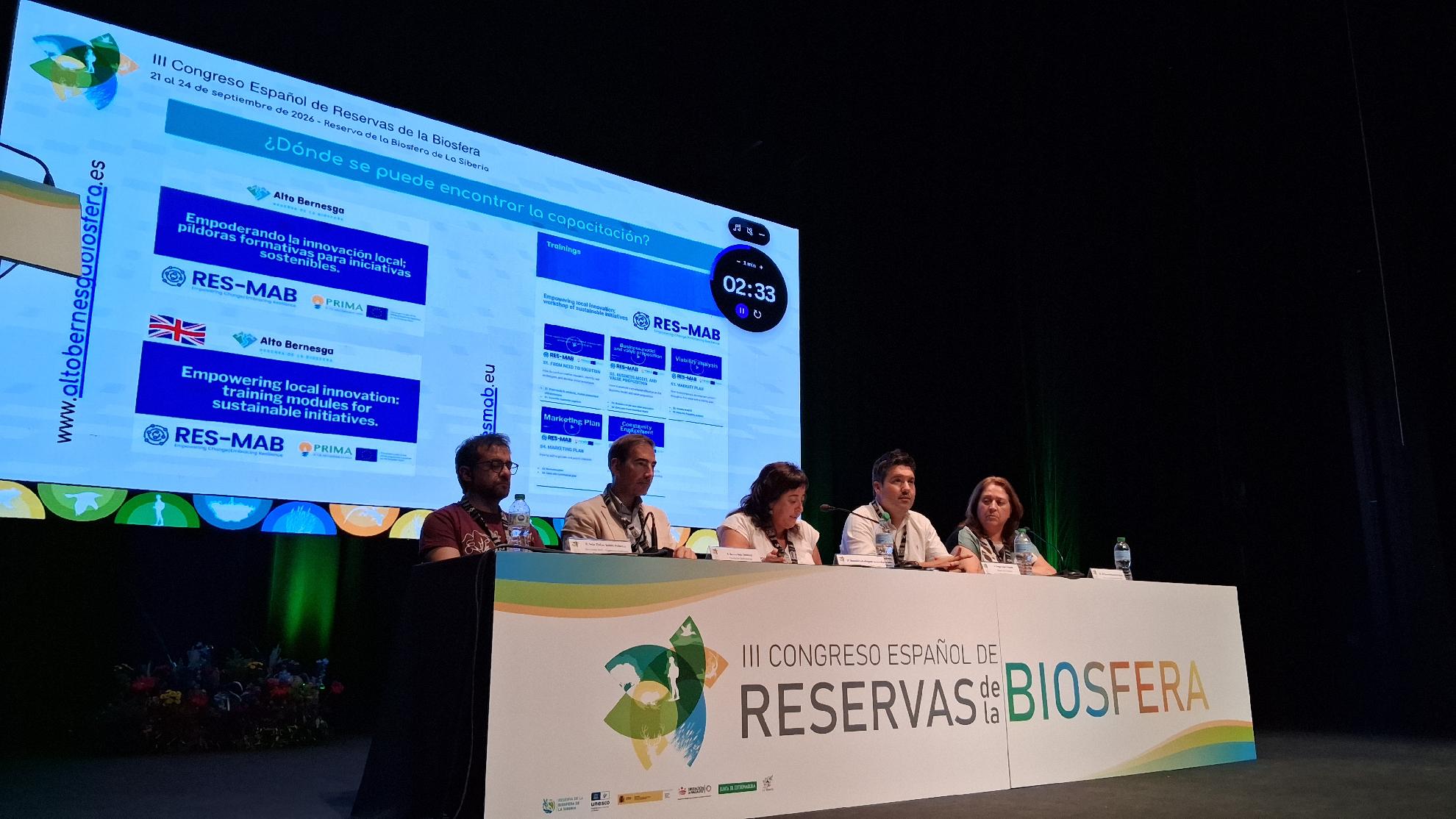
The presentation was complemented by two posters on RES-MAB: one dedicated to the project as a whole and the other focused specifically on the Alto Bernesga experience.
The Congress also allowed a closer look at the La Siberia Biosphere Reserve, declared by UNESCO in 2019 and which this year has expanded its surface area with the incorporation of new municipalities.
Throughout the meeting, different initiatives were presented that show how recognition as a Biosphere Reserve can become a tool to generate new opportunities for sustainable development, integrating natural heritage, culture and socio-economic activity.
Among the initiatives visited are new resources for ecotourism and the interpretation of natural heritage, such as inland beaches, the interpretation centre and different bird and deer observation points during the rut.
The Reserve is also promoting projects aimed at keeping alive and enhancing the local cultural heritage. Among them are the recovery of its own vocabulary in municipalities such as Castilblanco, the valorisation of festivals and the traditional foods associated with them, the development of new artisanal products and the initiatives of local associations for the transmission of traditional dances.
These experiences show a fundamental dimension of the MAB Programme: Biosphere Reserves are territories where conservation, knowledge, culture and sustainable development can work together to build resilience from the local level.
UNESCOMED's participation in the III Spanish Congress of Biosphere Reserves has made it possible to strengthen the links between the Spanish Network and the Mediterranean dimension of the MAB Programme, to share experiences and to make visible how cooperation between Reserves can generate knowledge, capacities and specific projects.
30 September 2026
Italy’s Monte Peglia UNESCO MAB Biosphere Reserve joins the MedMAB network, bringing the network to 73 Biosphere Reserves.
18 September 2026
From 14 to 18 September 2026, EuroMAB 2026 brought together members of the UNESCO Man and the Biosphere (MAB) community in the Mount Arrowsmith Biosphere Region, Canada, to exchange knowledge, share experiences and explore new ways of working together for people and nature.
15 May 2026
From 8th to 10th May, representatives of the International Centre for the Mediterranean Biosphere Reserves (UNESCOMED) participated in the 8th International Congress of the Argan Tree held in Essaouira, Morocco, under the theme “From Argan Forest to Arganiculture: The Argan Tree as a Pillar of Water Resilience for Ecosystems, Territories, and Communities.”
Dr. Roser Maneja, our Scientific Director, and Dr Quim Zaldo, researcher from the Forest Science and Technology Centre of Catalonia, attended the event and contributed to two round tables, one related to the WEFE nexus approach aligned with the RES-MAB project, and the other related to the governance of Biosphere Reserves.