In December 2022, 196 Parties to the UN Convention on Biological Diversity adopted the Kunming–Montreal Global Biodiversity Framework (GBF), a landmark global agreement designed to halt and reverse biodiversity loss. Since then, countries and communities worldwide have been seeking effective ways to accelerate its implementation at local and national levels. The new Hangzhou Strategic Action Plan 2026–2035, which will guide the Man and the Biosphere (MAB) Programme over the next decade, explicitly integrates the objectives of the GBF and other multilateral environmental agreements into its vision and action framework.
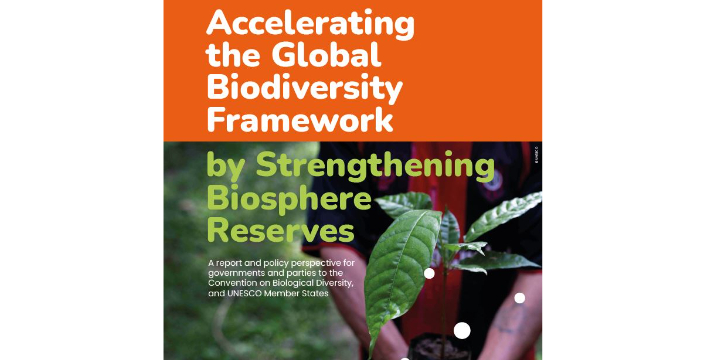
The new report, Accelerating the Global Biodiversity Framework by Strengthening Biosphere Reserves, contributes significantly to this effort. Produced by the BECOME project and funded by Biodiversa+, the report was launched at the 5th World Congress of Biosphere Reserves (WCBR) in September 2025 in Hangzhou, China.
The report highlights biosphere reserves as model territories that integrate conservation, sustainable development, and learning. These territories are uniquely positioned to translate global biodiversity targets into concrete local actions, including habitat restoration, participatory governance, community-led conservation, and innovative land management practices.
Drawing from global biodiversity data, expert consultations, literature reviews, and workshops within UNESCO’s Man and the Biosphere (MAB) Programme, the report provides a comprehensive overview of how the World Network of Biosphere Reserves (WNBR) already contributes to GBF implementation. It also provides practical recommendations to maximise this contribution in the coming decade.
Mediterranean contributions
The International Centre for the Mediterranean Biosphere Reserves was invited to review the report, helping ensure that Mediterranean perspectives and experiences were well represented. Several of the Centre’s comments were incorporated into the final version, strengthening its relevance for biosphere reserves across diverse socio-ecological contexts.
Mediterranean biosphere reserves are featured in the report as case studies showcasing how biosphere reserves contribute to the GBF:
13 Northern Spanish Biosphere Reserves are an example of connectivity within biosphere reserves, and the implementation of biodiversity-inclusive spatial planning.
Camargue Biosphere Reserve illustrates how biosphere reserves can halt species extinction.
The Arganeraie Biosphere Reserve showed the importance of resilient agroforestry practices that integrate traditional knowledge.
French Biosphere Reserves exemplify a successful initiative for local actor involvement.

These examples illustrate how Mediterranean ecosystems are already driving progress on GBF targets such as habitat conservation, restoration, and sustainable use. Their inclusion also reflects the growing recognition of the Mediterranean region as a pivotal area for biodiversity innovation and policy integration.
Looking ahead
The release of the report aligns with the adoption of the Hangzhou Strategic Action Plan 2026–2035, which sets the framework for the next decade of the MAB Programme. By fully integrating GBF objectives and other global environmental commitments, the Plan’s Objective A reinforces the strategic role of biosphere reserves in implementing international biodiversity goals.
The International Centre for the Mediterranean Biosphere Reserves welcomes the report as a timely tool to support Member States, biosphere reserve managers, and policymakers in strengthening the links between the GBF and the MAB Programme. Looking forward, the Centre remains committed to supporting Mediterranean biosphere reserves and contributing to international strategies aimed at halting and reversing biodiversity loss.
The report is available here, and in the future will be integrated in the new webpage section of resources for biosphere reserves.
28 January 2026
A new scientific paper analyses how the MAB Programme is implemented across Mediterranean biosphere reserves.
The study was made possible thanks to the involvement of 38 MedMAB members who responded to a survey circulated within the network.
The paper is a collaborative work of international experts in the framework of the International University Campus on Mediterranean Biosphere Reserves.
Mediterranean biosphere reserves are facing rapidly evolving policy expectations. Understanding how they interpret and apply UNESCO’s guidance has never been more important. A new study sheds light on how these sites translate into local action.
The paper, “Exploring implementation differences of UNESCO policy ...
15 January 2023
Following the closure of the Erasmus+ EduBioMed project, on capacity building for education and research applied to Mediterranean biosphere reserves, UNESCOMED has taken up its baton and its motto: "It's time to learn from biosphere reserves".
Therefore, from the UNESCOMED website, an interactive platform for the exchange of knowledge on Mediterranean biosphere reserves, we are launching a new series of training videos on biosphere reserves as part of the Massive Open Online Course (MOOC) produced in the framework of the EduBioMed project.
The series of short videos, which includes an initial inspirational lecture and 28 educational talks organised in 5 ...
27 January 2022
The Edu-BioMed project has published a new document to evaluate and give recommendations at the level of legal frameworks and governance mechanisms that influence the management and reality of Mediterranean Biosphere Reserves.